



When the angel Gabriel announced to the Blessed Virgin Mary that she would bear a son and that her son was to be called Jesus, which means Savior, and that he was to be the ruler of a kingdom that would never end, one could only imagine what she was thinking at that very moment. Since the blessed Mother is the Immaculate Conception, she responded by submitting to the will of the Father and thus assenting to the will of the Father and confirming her role as Mary, the Mother of God.
The description of Christ in St. John’s Gospel reveals Jesus being described as the Lamb of God who takes away the sins of the world.[1] Interestingly, these two descriptions of Christ are often downplayed or ignored in the religious development of a child. The preference, regardless of the age of religious instruction and formation, I argue, is to describe and insist that Jesus will forever be a perpetual friend. This catechetical phenomenon unfortunately happens more often than naught due to a disassociation of Jesus’ suffering for the sins of humanity and from Jesus himself. This may sound a bit extreme, but it is a reality that still exists within the current catechetical landscape.
Case in point, I was asked to present to a group of school parents about how to strengthen their children’s Catholic identity within the home. Parents who were present were curious about how to refashion their home environment to help their children foster a stronger and healthier relationship with Jesus Christ. To start, I proposed the following question: What was your most difficult experience with God in relation to your children? As the parents pondered the question somewhat perplexed, one parent answered, “When my children would not behave at mass,” another said, “when my son did not want to go to mass with me,” and another commented, “I had difficulty getting my children to pray with me.” All of these responses were predicated on an attempt to have their children exercise their Catholic faith through various modes of prayer, with the most important being the Mass.
It was important to reassure these parents that they were not failing in raising their children in the Catholic faith; they simply had to adjust their thinking and approach. When I asked the parents how they spoke about Jesus in the home, the majority with children across multiple age groups, from five-year-olds to teens, commented that they spoke of Jesus as their friend and how they can develop a friendship with Jesus. I then asked two questions, one, if they spoke of Jesus as Savior and Lord? Two, whether anyone had established a consistent prayer practice in the home, or prayed with or over their children in the evening before going to bed. Only one parent responded, yes to both of my questions. Once the initial pause had worn off, I explained to the parents that it is important that the child observe the parents' religious disposition and behavior. A strengthening of their physical and religious expression of the Catholic faith is the most important first step in demonstrating the Catholic faith to a child, regardless of age. By demonstration, I explained how each parent should serve first and foremost as a visible disciple of prayer to their children when they wake up in the morning, when they go to bed, before and after every meal, during the day, when someone is in need, and so forth.
One of the parents said that they try very hard to teach their children that Jesus is their friend. I immediately told the mother, " Don’t forget to tell them that Jesus is their Savior as well. Jesus came to save us first, and not to befriend us.” She paused, and the rest of the parents gave a stunned look as if this was the first time hearing about associating Jesus with salvation. The notion of Jesus as a friend disregards Christ as Savior and why the Word became flesh to free us from the pain of sin and death. The importance of identifying and associating Christ as Savior brings to awareness the teaching on original sin, free will, concupiscence, sin, grace, the Church, the sacramental life, the paschal mystery-Jesus’ life, death, resurrection, and ascension.
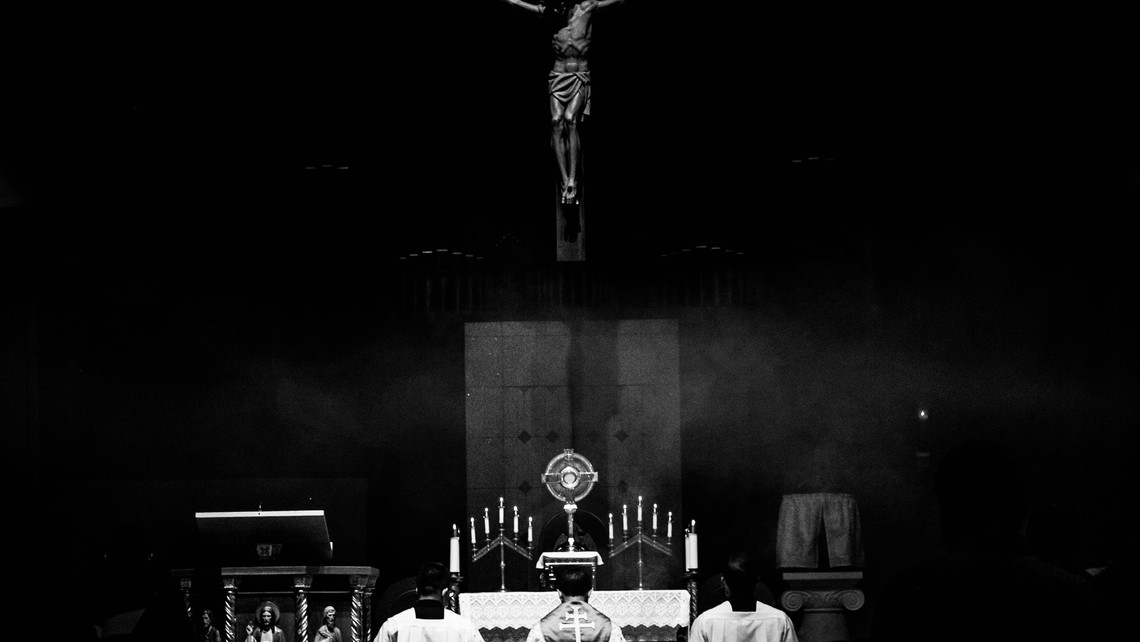
As the concept of friendship is embedded in the mind of the child, the concept of savior, salvation, sin, and sacramental living tends to be either ignored or never introduced. If a parent wants their child to engage in their Catholic faith, then it must first be demonstrated in the home through various credible motives of faith directed toward Jesus Christ and the expression of a relationship with Christ in the sacramental life. Examples of these credible motives are having a sacred space with a crucifix, having the sacred space reflect the liturgical season, the recitation of the Angelus, the rosary, and the Divine Mercy chaplet to introduce the language of Jesus associated with Him as Savior.
It is dangerous, I argue, to assume that a child can only relate to Jesus as a friend. This introduces a false piety that ignores the necessity of understanding the cross and its relationship with suffering. The Catechism reminds us of the importance of affirming Jesus as Savior,
The Son of God, who came down "from heaven, not to do [his] own will, but the will of him who sent [him]", said on coming into the world, "Lo, I have come to do your will, O God." "And by that will we have been sanctified through the offering of the body of Jesus Christ once for all." From the first moment of his Incarnation the Son embraces the Father's plan of divine salvation in his redemptive mission: "My food is to do the will of him who sent me, and to accomplish his work." The sacrifice of Jesus "for the sins of the whole world" expresses his loving communion with the Father. "The Father loves me, because I lay down my life", said the Lord, "[for] I do as the Father has commanded me, so that the world may know that I love the Father."[2]
We are reminded by St. John the Baptist that Jesus is indeed the Lamb of God who came to take away the sins of the world. This is the language that should be instilled in the hearts and minds of our children: Jesus is Lord, Savior, and King. Jesus’ friendship is synonymous with his suffering and death for our salvation. Our Divine friend laid down his life so that we might have life and have it more abundantly.[3]
Latest Posts

Do not underestimate the role of the Archangels in our battle between good and evil.
Within human history, the role of Angels is often identified as a counselor, a messenger, or one’s personal conscience. From a secular perspective, an...Read more

Did the Paralytic Receive Something More Important than Physical Healing?
There is something distinctively beautiful in the way God made us. We possess an identity that reflects God’s infinite love and allows us to...Read more

How do the Seven Sorrows of Mary Lead us to Holiness?
When Simeon finally encounters the Christ-child and proclaims the significance of his birth, he proclaims that Jesus represents the fall and rise of many...Read more

Archive
- February 2024 (4)
- January 2024 (4)
- December 2023 (2)
- November 2023 (4)
- October 2023 (5)
- September 2023 (4)
- August 2023 (3)
- July 2023 (4)
- June 2023 (2)
- May 2023 (5)
- April 2023 (3)
- March 2023 (1)
- February 2023 (4)
- January 2023 (4)
- December 2022 (3)
- November 2022 (3)
- October 2022 (2)
- September 2022 (4)
- August 2022 (4)
- July 2022 (2)
- June 2022 (2)
- May 2022 (2)
- April 2022 (2)
- March 2022 (2)
- February 2022 (3)
- January 2022 (5)
- December 2021 (3)
- November 2021 (3)
- October 2021 (3)
- September 2021 (4)