



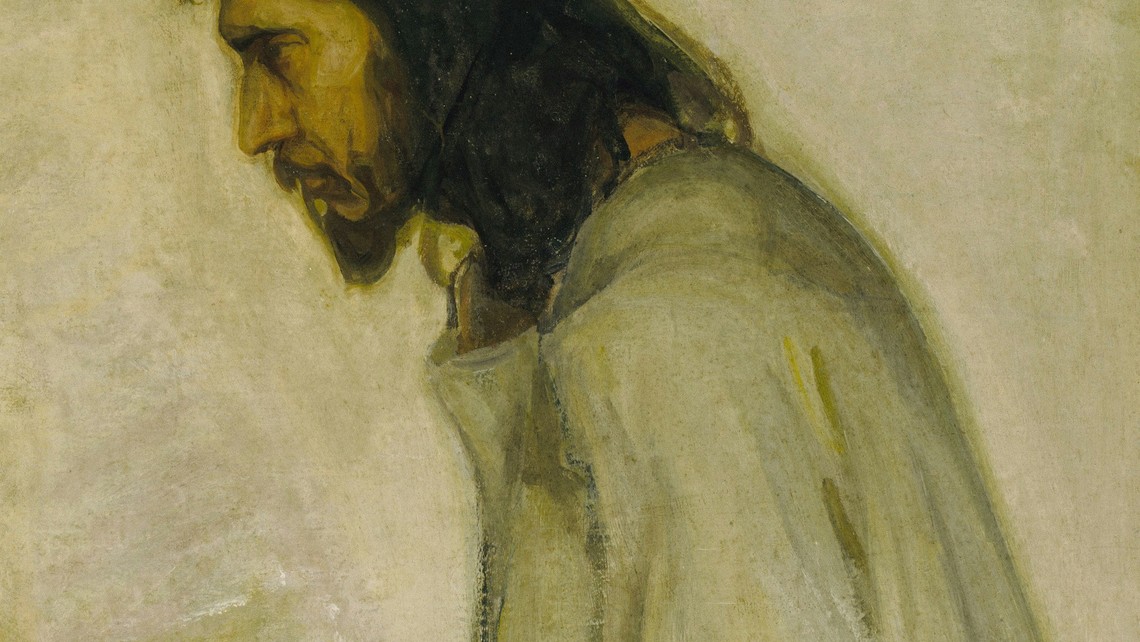
When Jesus begins his teaching mission in Nazareth on the Sabbath, he takes his rightful place in the synagogue as the Divine Teacher. He proceeds to reference the words of the Prophet Isaiah and lays out the method and content of his salvific message,
The Spirit of the Lord is upon me, because he has anointed me to preach good news to the poor. He has sent me to proclaim and release to the captives and recovering of sight to the blind, to set at liberty those who are oppressed, to proclaim the acceptable year of our Lord.[1]
The opportunity for Jesus to teach in the synagogue underscores Jesus' identity as Teacher and Savior. However, there is another important element associated with Jesus’ teaching ministry, and that is healing. St. Luke’s Gospel reveals a series of instances where Jesus’ acts of teaching and healing coincide: The healing of the man with an unclean spirit[2], Peter’s mother-in-law[3], the healing of the leper,[4]and the man with the withered hand[5] demonstrate Jesus’ approach to nourish and nurture the soul of the person.
The physical manifestations of healing are central to the conversion of the hearts of the people Jesus encounters. The Incarnation is a primary example of how God knew that man required the ability not only to hear but to see God’s love unveiled through the Incarnate Word Jesus Christ. This approach becomes more vivid where, after the selection of the twelve Apostles, Jesus does the following,
And he came down with them and stood on a level place, with a great crowd of his disciples and a great multitude of people from all Judea and Jerusalem and the seacoast of Tyre and Sidon, who came to hear him and to be healed of their diseases; and those who were troubled with unclean spirits were cured. And all the crowd sought to touch him, for power came forth from him and healed them all.[6]
Jesus reveals a very important point that is neglected within the Catholic teaching profession: the student’s soul must be addressed before anything else. It is not ironic that Luke’s Gospel records Jesus’ catechetical application of the beatitudes as a means to confirm one’s life to the Father through the Son. This approach aims to lovingly and firmly help the student begin to lift his eyes towards heaven and nothing else. If a student comes into a classroom with his eyes firmly placed on something other than God, then he may not be receptive to the message of the Gospel, let alone anything doctrinal or catechetical in nature.
The Catechism of the Catholic Church sheds light on Jesus’ approach,
What moves us to believe is not the fact that revealed truths appear as true and intelligible in the light of our natural reason: we believe because of the authority of God himself who reveals them, who can neither deceive nor be deceived. So that the submission of our faith might nevertheless be in accordance with reason, God willed that external proofs of his Revelation should be joined to the internal helps of the Holy Spirit. Thus, the miracles of Christ and the saints, prophecies, the Church's growth and holiness, and her fruitfulness and stability are the most certain signs of divine Revelation, adapted to the intelligence of all"; they are "motives of credibility" (motiva credibilitatis), which show that the assent of faith is "by no means a blind impulse of the mind".[7]
The teaching of the Catholic faith, I argue, requires an element of spiritual healing because the student is not an object but a human soul. Thus, the immediate priority for any Catholic educator is the disposition of the student’s soul. Hence, the immediate need is to address the obstacles to faith that may have matriculated in the hearts and minds of students. This is where the notion of healing, specifically spiritual healing, provides a resuscitation of faith in Jesus Christ. The most important example of the teaching-healing relationship is the teacher’s demonstrative love for Jesus Christ and His Church in joy and suffering. Students need to encounter credible Catholic witnesses, especially when faced with the temptations to turn to something or someone else other than Jesus Christ.
The introduction of sacred elements of the Catholic faith serves as entryways to address the spiritual healing-teaching relationship. The use of classical music at the start of each class, such as Vivaldi; sacred art like the Prodigal Son by Rembrandt; opportunity to develop an active prayer life through a reflection on the daily readings, liturgy of the hours, weekly Eucharistic Adoration, devotion to a particular saint, and an introduction to a daily examination of conscience are some practical steps one may introduce to students within the spiritual healing-teaching relationship. Addressing the disposition of the soul and its conformity to Christ should be the priority of any Catholic educator. This reveals, I argue, the intimate relationship between spiritual healing and the teaching of the Catholic faith.
Let not sin therefore reign in your mortal bodies, to make you obey their passions. Do not yield your members to sin as instruments of wickedness, but yield yourselves to God as men who have been brought from death to life, and your members to God as instruments of righteousness. For sin will have no dominion over you, since you are not under law but under grace.[8]
Latest Posts

Is the Aim to Teach Toward Heaven?
As the dawn of a new school year approaches, the inevitable convergence of parents, students, and teachers presents an educational opportunity that, from a...Read more

Does Speaking About Christ Terrify You?
It is not often that you encounter a group of people who exhibit a sense of terror when asked about the first time they...Read more

Marital Sacrifice and the Way of the Cross
The act of sacrifice associated with the sacrament of marriage is heard, but I argue often misunderstood because of the preoccupation with the view...Read more

Archive
- January 2024 (4)
- December 2023 (2)
- November 2023 (4)
- October 2023 (5)
- September 2023 (4)
- August 2023 (3)
- July 2023 (4)
- June 2023 (2)
- May 2023 (5)
- April 2023 (3)
- March 2023 (1)
- February 2023 (4)
- January 2023 (4)
- December 2022 (3)
- November 2022 (3)
- October 2022 (2)
- September 2022 (4)
- August 2022 (4)
- July 2022 (2)
- June 2022 (2)
- May 2022 (2)
- April 2022 (2)
- March 2022 (2)
- February 2022 (3)
- January 2022 (5)
- December 2021 (3)
- November 2021 (3)
- October 2021 (3)
- September 2021 (4)
- August 2021 (4)