



There is something distinctively beautiful in the way God made us. We possess an identity that reflects God’s infinite love and allows us to reciprocate that love to Him and to one another. Because of the relationship between the body and soul, both work in tandem to build on one another, in the same way grace builds and perfects nature. Hence, the origin of our creation was meant to be in perfect union with our Father in heaven. However, when Adam and Eve chose an act of love that was not from God, it shattered, not destroyed, the gift God had made and provided for them.
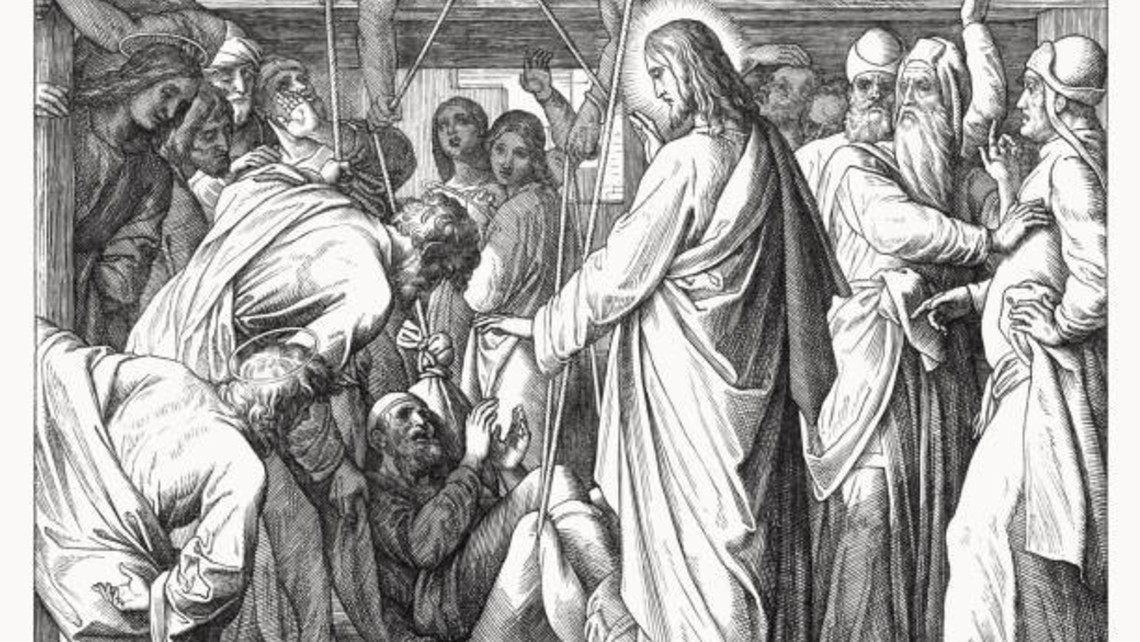
As a result of the fall, dissatisfaction occurred with how Adam and Eve perceived God’s love. Their relationship now requires a resuscitation, the necessity to redeem what was lost. This series of events led us to an important salvific event: the birth of the Son of God, Jesus Christ, the Incarnate Word and Savior of the World. An event that demonstrates the love of the Father for his children through the Son is found in the healing of the paralytic (Lk 5:17-26). This miraculous event describes the physical state of a man, bodily withered and broken, yet sustained in faith and hope that the Son of God would heal him. The men assisting the paralytic believe that Jesus can heal their friend and demonstrate their faith through their willingness to lower their brother from the roof of the home where Jesus was speaking.
The interaction between Jesus and the paralytic is direct and yet transformative; when Jesus sees their faith, He tells the paralytic, Man, your sins are forgiven you (Lk 5:20). Jesus’s priority upon witnessing the faith of the paralytic is the healing of his soul, the first order of grace instituted by God the Father in every human being. With Scribes and Pharisees chastising Jesus for healing the soul of the paralytic, one can only imagine the vileness of their behavior toward the Divine Healer, as Jesus then proceeds to physically heal the paralytic by commanding him to rise, take up his bed, and go home (Lk 5:24). The moment the paralytic rose and began to walk home, he praised God, and all present marveled at what had occurred.
When Jesus forgives the sins of the paralytic, he receives something infinitely more important than his ability to walk again: the healing of his soul. Even though the paralytic was physically disabled, viewed as a nuisance and waste to society, he received an unexpected gift: the healing of his soul. The paralytic’s faith never wavered throughout the entire encounter with Christ. The moment Jesus absolves the paralytic of his sins, it confirms the paralytic's humility in how he presented himself to Christ and the faith he professes, convinced that Jesus would heal him. Jesus is the Divine physician for both the body and soul, and reveals his desire to save souls as witnessed by the paralytic. The paralytic is no longer paralyzed in body and soul; both have been healed. The Catechism affirms Christ’s action, describing his mission as a work of healing and salvation (CCC 1421).
The soul of the paralytic has been reawakened as evidence of his desire to praise God after he received the ability to walk again. The man’s physical and spiritual paralysis has been removed, and he is now confirmed as a disciple of Jesus Christ. In the Gospel of St. John, we are reminded of the relationship between faith and eternal life,
For he whom God has sent utters the words of God, for it is not by measure that he gives the Spirit; the Father loves the Son, and has given all things into his hand. He who believes in the Son has eternal life; he who does not obey the Son shall not see life, but the wrath of God rests upon him (Jn 3:34-36).
The healing of the paralytic reminds us that Jesus values both our body and soul; hence the healing of both the physical and spiritual state of the paralytic. Christ provides a witness to all present and a clear reminder that physical healing is not the highest order. The healing of the soul is the highest order and salvific priority. The most debilitating physical disease cannot supplant a diseased soul. For the paralytic, being forgiven for his sins, I argue, allows him, with a clear spiritual state of mind, to understand the significance of his physical healing and thus acknowledge Christ for his healing. The paralytic is now welcomed back home, renewed to serve and praise the Lord.
Latest Posts

Is the Aim to Teach Toward Heaven?
As the dawn of a new school year approaches, the inevitable convergence of parents, students, and teachers presents an educational opportunity that, from a...Read more

Does Speaking About Christ Terrify You?
It is not often that you encounter a group of people who exhibit a sense of terror when asked about the first time they...Read more

Marital Sacrifice and the Way of the Cross
The act of sacrifice associated with the sacrament of marriage is heard, but I argue often misunderstood because of the preoccupation with the view...Read more

Archive
- January 2024 (4)
- December 2023 (2)
- November 2023 (4)
- October 2023 (5)
- September 2023 (4)
- August 2023 (3)
- July 2023 (4)
- June 2023 (2)
- May 2023 (5)
- April 2023 (3)
- March 2023 (1)
- February 2023 (4)
- January 2023 (4)
- December 2022 (3)
- November 2022 (3)
- October 2022 (2)
- September 2022 (4)
- August 2022 (4)
- July 2022 (2)
- June 2022 (2)
- May 2022 (2)
- April 2022 (2)
- March 2022 (2)
- February 2022 (3)
- January 2022 (5)
- December 2021 (3)
- November 2021 (3)
- October 2021 (3)
- September 2021 (4)
- August 2021 (4)