



When contemplating a relationship with Jesus Christ, would you rather be in the sight of him or be in a relationship with him? It is an important question to consider in light of Jesus’ resurrection. Why? When you read the events of Christ’s life in relation to the Apostles, the Apostles before Jesus’ death and resurrection were always within his sight, meaning they saw him but were in full communion with him. Jesus intended to lead the Apostles from a condition of sight to an actual living intimate relationship with the Son of God. Examples of this intimate transition include when Jesus bestows the gift of power and authority to bind and loose upon the Apostles; the gathering with Thomas that addresses Thomas’ doubt that Jesus actually rose from the dead; and the encounter at the Sea of Tiberias. These events address the question posed because of the significance of being within the sight of Christ before Jesus’ death and resurrection and then afterward in having an intimate relationship with him. The same questions can be proposed about the sacramental life, whether we choose to be within the sight of the sacraments or actively engage them.
In the Sea of Tiberias discourse in St. John’s Gospel[1] the Apostles do not recognize Christ until after he provides them with a symbolic number of fish, one hundred and fifty-three to be exact, which reveals the responsibility the Apostles have been given to evangelize and catechize the whole world. Even after witnessing Jesus’ miraculous life on earth, the Apostles revert to their original vocation as fishermen instead of their new identity as fishers of men. Christ’s presence reawakened and renewed their new identity as disciples and Apostles; they are no longer in the sight of Christ but in him. The new consecrated identity the Apostles receive redirects them to engage the world and spread the salvific message of Christ.
As new men, Peter and his fellow Apostles are tasked to introduce the world to Jesus Christ, who he is, who he was, why he came, and what he left us. The transmission of faith involves a new way of living that is now sacramental in nature, beginning with the first sacrament that Christ instituted, baptism. The new relationship between God and man instituted by the Son calls man into communion with Christ, not autonomous from him. This is why Jesus became man, and why the Logos-the Incarnate Word-became our new identity. In the new way of being, living, and preaching, Jesus, the Son of God, reintroduced God’s divine plan for humanity by becoming man in all things except sin; hence, the nature of his hypostatic identity as the Son of God and the Son of man.
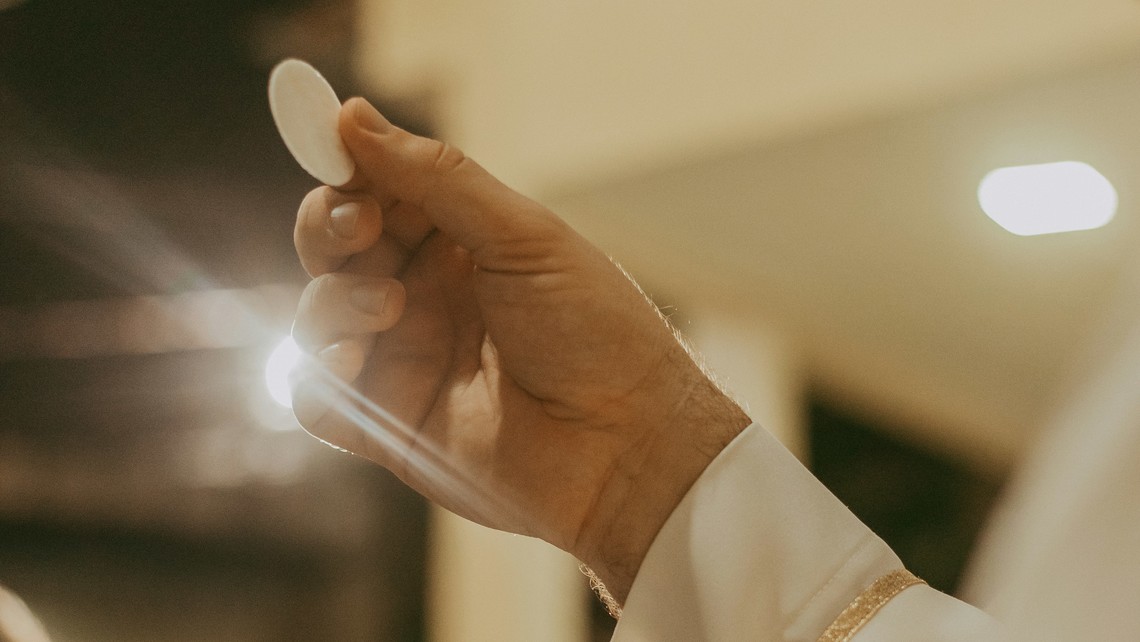
St. Paul provides further context sacramentally in this regard, where he directly appeals to the people of Corinth to shun the worship of idols[2] and to understand that the cup of blessing and the bread broken for our salvation are a direct participation in the body of Christ.[3] Our participation in the salvific acts of Christ reveals the source and summit of the Christian life, the Holy Eucharist.
For I received from the Lord what I also delivered to you, that the Lord Jesus on the night when he was betrayed took bread, 24 and when he had given thanks, he broke it, and said, “This is my body which is for[a] you. Do this in remembrance of me.” 25 In the same way, also the cup, after supper, saying, “This cup is the new covenant in my blood. Do this, as often as you drink it, in remembrance of me.” 26 For as often as you eat this bread and drink the cup, you proclaim the Lord’s death until he comes.[4]
The Catechism reaffirms the necessity of the sacramental life, specifically the Holy Eucharist, quoting St. Thomas Aquinas, who identifies the Holy Eucharist as the sacrament of all sacraments, to which all other sacraments are ordered as to their end.[5] St. Paul’s discourse bluntly reminds us of the necessity of the sacramental life because of its author, Jesus Christ, who died to institute the sacramental life for our salvation. Bear in mind that the words of Christ upon his institution of the sacraments have provided us with an opportunity to encounter him more intimately by receiving the gift of grace associated with the sacraments to live in virtue and charity. The following sequence from the Catechism exposes the necessity of the sacramental life and the danger in divorcing yourself from it,
Jesus' words and actions during his hidden life and public ministry were already salvific, for they anticipated the power of his Paschal mystery. They announced and prepared what he was going to give the Church when all was accomplished. The mysteries of Christ's life are the foundations of what he would henceforth dispense in the sacraments, through the ministers of his Church, for "what was visible in our Savior has passed over into his mysteries.[6]
The Church affirms that for believers the sacraments of the New Covenant are necessary for salvation. "Sacramental grace" is the grace of the Holy Spirit, given by Christ and proper to each sacrament. The Spirit heals and transforms those who receive him by conforming them to the Son of God. The fruit of the sacramental life is that the Spirit of adoption makes the faithful partakers in the divine nature by uniting them in a living union with the only Son, the Savior.[7]
The sequence expressed in the Catechism reveals the intimate relationship between the sacraments and salvation because they hinge on their author, Jesus Christ, who instituted and ultimately died for us to receive them. To divorce ourselves from these gifts is to ignore or possibly reject an opportunity to develop a relationship with Christ and hence a possible path toward heaven. Let us not forget that the battle between grace and sin is intimately intertwined in the sacramental life of the Church because within the nature of the sacraments lies the salvific reality of Christ, who died for our sins.
How shall the devil maintain his throne in one who builds a throne for Christ in his heart?
St. Ambrose
Latest Posts

The Risk of Making the Sign of the Cross
There is something to consider and ponder when the expression of a religious gesture can foster such discomfort amongst people, even those who are...Read more

The Risk of Fearing God
The idea that human fear is intimately associated with God may sound and appear as either an anomaly or a contradiction. In a worldview...Read more
The Risk of Holiness
Within Sacred Scripture, it is fair to say that we encounter many spiritual and physical dramas between God and man. One who may be...Read more
