



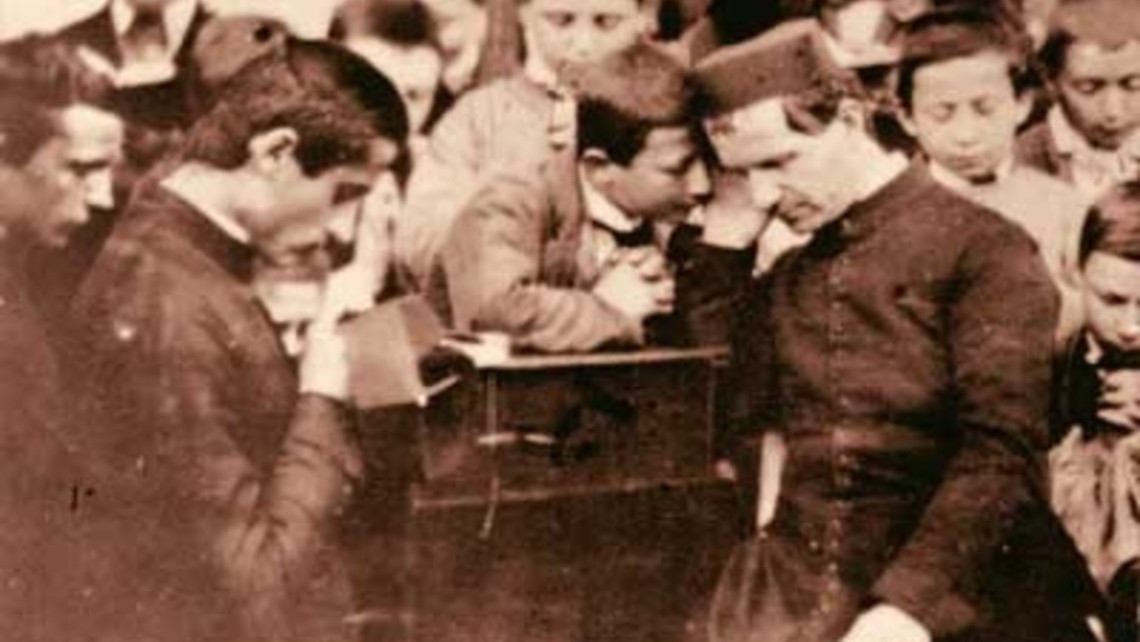
Children are not subjects but a reminder of the revelation of God’s love, possessing a visible reality that requires any teacher to both nurture and nourish the soul of a child. The premise of any teaching environment requires and involves the exercise of a loving environment directed at the soul and care of the child, and not the initial regurgitation of information. These important attributes were skillfully and lovingly exercised by St. John Bosco, who, upon encountering the displaced and discarded children of Turin, Italy, lovingly sought to offer these children of the street a refuge of love through his preventive teaching methodology of reason, religion, and kindness.
Don Bosco’s preventive instructional methodology fostered an environment that echoed a desire for God and the salvation of souls. This was his intent for any child that entered his oratory seeking physical and spiritual refuge. For St. John Bosco, the theological virtue of love was the hallmark of his preventive system, which also meant exerting loving discipline on his boys of the oratory if they acted out against the rule of the oratory. The implementation of the Preventive System (Reason, Religion, and Kindness) focused on bringing the child closer to Christ. Reason focused on providing a loving environment to provide an opportunity for the child to learn. The goal of this first principle is to develop good Christians and useful citizens. The teacher in this teaching process is the bridge toward a child’s discovery of the world through a Catholic lens.
Religion stressed the ugliness of sin and the value of living a virtuous life. The aim for the young man in the oratory was to develop the intellectual and physical gifts and direct him toward a greater good. There are five distinctive characteristics behind the exercise of religion aimed to help the young man attain personal holiness:
- Holiness of ordinary life
- The joy and optimism of holiness
- Centrality of Confession
- The Holy Eucharist
- Love of Mary
Kindness emphasizes the virtue of love. St. John Bosco would stress: “Let us make ourselves loved, and we shall possess their hearts.” In other words, our Christian witness must be constant for the development of the child. The learning environment should be warm and inviting, not cold. The family spirit reigned; he did this through rapport, friendliness, presence, respect, attention, dedication to service, and personal responsibility. The Preventive System aims to guide the child to know that he is a precious gift created in God’s image and likeness out of love.
St. John Bosco was very direct in his intention to save the souls of every young man he encountered in the streets of Turin and those who would arrive in front of his Oratory. Professing the reality of Jesus Christ and demonstrating Christ’s love through His crucifixion were very important to Don Bosco because they centered on his teaching methodology of reason, religion, and kindness. Frequent reception of the sacraments of reconciliation and the Holy Eucharist served as the pillars of his methodology and language of faith. These external proofs are what the Catechism of the Catholic Church calls “motives of credibility,”[1] examples and models of the faith that provide a clear context of how to express our assent of faith to Christ and His Church.
The direct and relentless nature of his teaching methodology focused on caring for the soul of the child. The entire teaching structure of the oratory focused on instruction in the Catholic faith, with emphasis on the daily and weekly reception of the sacraments, exercise in self-discipline, and the desire to leave a holy and virtuous life. Any Catholic educator would do well to apply St. John Bosco’s Preventive System of learning towards their students. Why, because it requires that we address the soul of the child first, as echoed by the following practical steps,
- Students desire to be loved and accepted, no matter what age.
- The goal is to get them to love you through your authentic witness of the faith.
- The environment should reflect a desire to lead students into a journey with Jesus Christ.
In his Apostolic Exhortation, Catechesis In Our Time, St. John Paul II provides us with an instructional context about the aim of our catechetical instruction that reflects St. John Bosco’s preventive system of instruction.
The aim of catechesis is to be the teaching and maturation stage, that is to say, the period in which the Christian, having accepted by faith the person of Jesus Christ as the one Lord and having given Him complete adherence by sincere conversion of heart, endeavors to know better this Jesus to whom he has entrusted himself to know His mystery the kingdom of God proclaimed by Him . . .[2]
Every encounter with a child within a Catholic learning environment should exude joy from the teacher, even when tempted not to. The delivery of information, whether academic or spiritual in nature, is meaningless without the authentic, joyful witness of the teacher as an active disciple of Jesus Christ. At the core of any Catholic teaching moment lies the opportunity to guide a child toward the loving embrace of Christ and to strengthen his embrace through the sacramental life of the Church.
The lasting impression for any child is the joy they witness from the teacher who earnestly desires to lead them to holiness. For St. John Bosco, the teaching of the Catholic faith encompassed his entire teaching philosophy, and it is something we should embrace:
Frequent confession, Communion, and daily Mass are the pillars that must support the edifice of education from which we propose to banish threats and the rod. Never force the boys to frequent the sacraments. Instead, encourage them and give them every opportunity to do so. During retreats, triduums, novenas. Sermons and catechism classes, the beauty, the grandeur, and the holiness of our religion must always be dwelt on, for in the sacraments it offers all of us an easy and useful means to attain peace of mind and eternal salvation.[3]
Latest Posts

The Aim of Christian Instruction
There is an important narrative that many Catholic educators neglect to present to their students when introducing, teaching, and discussing the Catholic faith. The...Read more

What Do You Mean? When Religious Instruction Becomes Incoherent
Within the walls and corridors of an academic institution that proposes to convey and reaffirm the teachings of the Catholic Church, prudence would dictate...Read more

The Primacy of Teaching As an Act of Love
The identity of a teacher is often misperceived as an individual who simply conveys information, regurgitates concepts, and assesses a student's academic competency. In...Read more
