



Fra Angelico’s vision of the Annunciation reveals to us the Blessed Mother’s expression of stillness and silence. The importance of these attributes reveals the initial acceptance of a Divine message with humility and docility. When Mary is greeted by St. Gabriel, the Archangel affirms Mary’s identity by describing her as “Hail Mary, full of grace,” as revealed in St. Luke’s Gospel (1:28). Throughout her encounter with St. Gabriel, Mary teaches us about the importance of silence when being spoken to by God through one of His angelic messengers. Though Mary is described as troubled, one can only imagine her wonder, concern, and initial stunned silence upon hearing St. Gabriel’s description of her as full of grace.
As the exchange between Mary and St. Gabriel continues, Mary confirms her identity as the Immaculate Conception, the God-Bearer, and the Mother of God (CCC 495) when she proclaims, “I am the handmaid of the Lord; let it be done to me according to your word” (Lk 1:38). Her fiat, which describes her free-will assent to the Father, affirms her yes to become the Mother of Jesus, which confirms the salvation of mankind. Mary’s docile and humble obedience vanquishes Eve’s disobedience and unites her to the work of her son Jesus Christ (CCC 494).
Mary’s consent to the will of God described in the Annunciation reveals the path Mary chose that would ultimately lead her to the foot of the Cross of her Son. The Catechism states that Mary serves as the sign of the way to the Cross of her Son (CCC 2674). There is a unique cooperation revealed by the Blessed Mother, first through her initial silent acceptance of the will of the Father, and second through her vocal affirmation of the will of the Father and, when asked about her Son, would redirect the inquirer to her Son. The example of the wedding Feast at Cana, where Mary directs the servants to do whatever her Son tells them to do (Jn 2:5), identifies Mary’s participation in the Divine mysteries of her Son’s life and provides context in the development of the Rosary and the opportunity this specific prayer provides us to engage these mysteries in holy silence.
Some may view the association of the Rosary with silence as incompatible; however, the recitation of the Rosary possesses a dual purpose. One, to focus on the specific mysteries of Christ’s life; second, to engage in spiritual silence meditating on each mystery even if involved in vocal prayer. If we take the structure of the Rosary and specifically focus on the prayer to our Blessed Mother, the Hail Mary serves as an opportunity to silently reflect on the joy God exhibits to Mary through St. Gabriel, identifying her as Hail, full of grace. The Lord is with Mary and reveals how much the Lord loves her, providing us with a clear example of God’s omnipotent love for his children.
Identifying Mary as “blessed” confirms the Blessed Mother’s faith in God the Father and serves as an example of Mary’s fidelity to the will of the Father. She is the mother of God because she has been granted the gift of bearing the Son of God, Jesus. The final petition of the Hail Mary is seeking Mary’s prayers, acknowledging her as the Mother of Mercy. The recitation of the Rosary is an examination of the mysteries of the life of Christ, where the Blessed Mother is intimately involved in the salvation of humanity through her Immaculate Conception, Annunciation, and Assumption, and Coronation as Queen of Heaven and Earth.
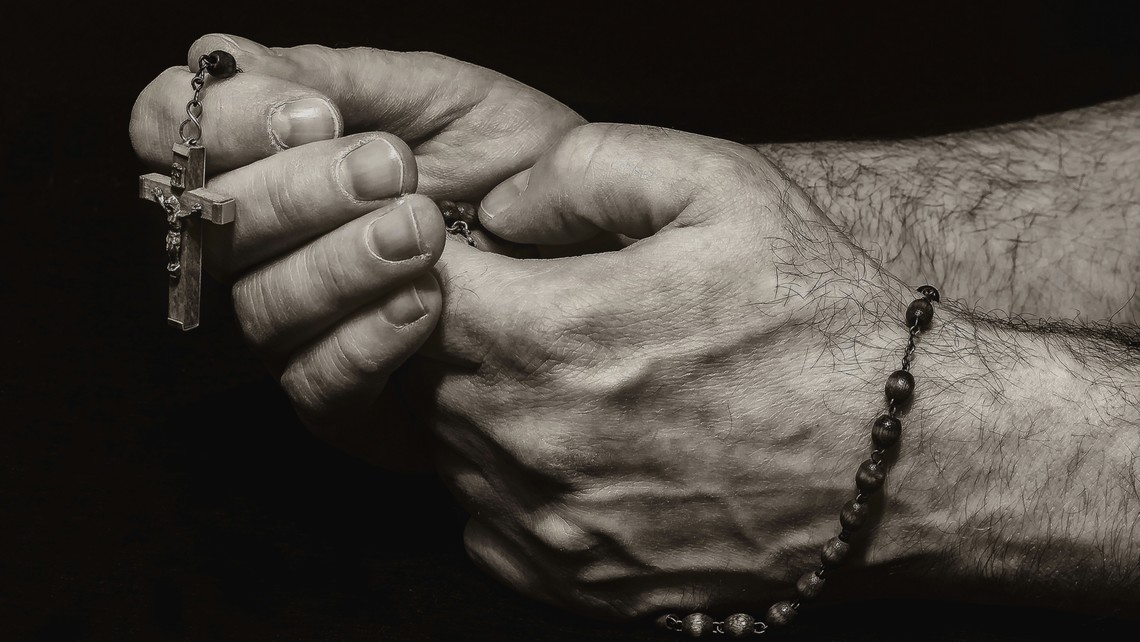
The rosary provides us with an opportunity to silently raise our heart and mind to Christ. It is an incarnational prayer that directs us to pray not only from the head but from the heart. To conclude, I close with two excerpts from St. John Paul II’s Apostolic Letter on the Rosary (Rosarium Virginis), which summarize the gift of silence in the rosary,
The Rosary, precisely because it starts with Mary's own experience, is an exquisitely contemplative prayer. Without this contemplative dimension, it would lose its meaning, as Pope Paul VI clearly pointed out: “Without contemplation, the Rosary is a body without a soul, and its recitation runs the risk of becoming a mechanical repetition of formulas, in violation of the admonition of Christ: 'In praying do not heap up empty phrases as the Gentiles do; for they think they will be heard for their many words' (Mt 6:7). By its nature the recitation of the Rosary calls for a quiet rhythm and a lingering pace, helping the individual to meditate on the mysteries of the Lord's life as seen through the eyes of her who was closest to the Lord. In this way, the unfathomable riches of these mysteries are disclosed” (12).
Listening and meditation are nourished by silence. After the announcement of the mystery and the proclamation of the word, it is fitting to pause and focus one's attention for a suitable period of time on the mystery concerned, before moving into vocal prayer. A discovery of the importance of silence is one of the secrets of practicing contemplation and meditation (31).
Latest Posts

Are We Called to Spiritual Mastery?
A principal element on our path to calvary is the importance of self-mastery of our behaviors, thoughts, and actions that express a visible contradiction...Read more
Spiritual Indifference and the Road to Calvary
In a particularly striking conversation between Jesus and his disciples, the disciples ask Jesus why he uses parables (stories) to explain what he is...Read more
Does the Way of the Cross, foster reverence for the Holy Eucharist?
At some point in life, a person will witness a series of events that will leave him asking a simple rhetorical question: “Did I...Read more
