



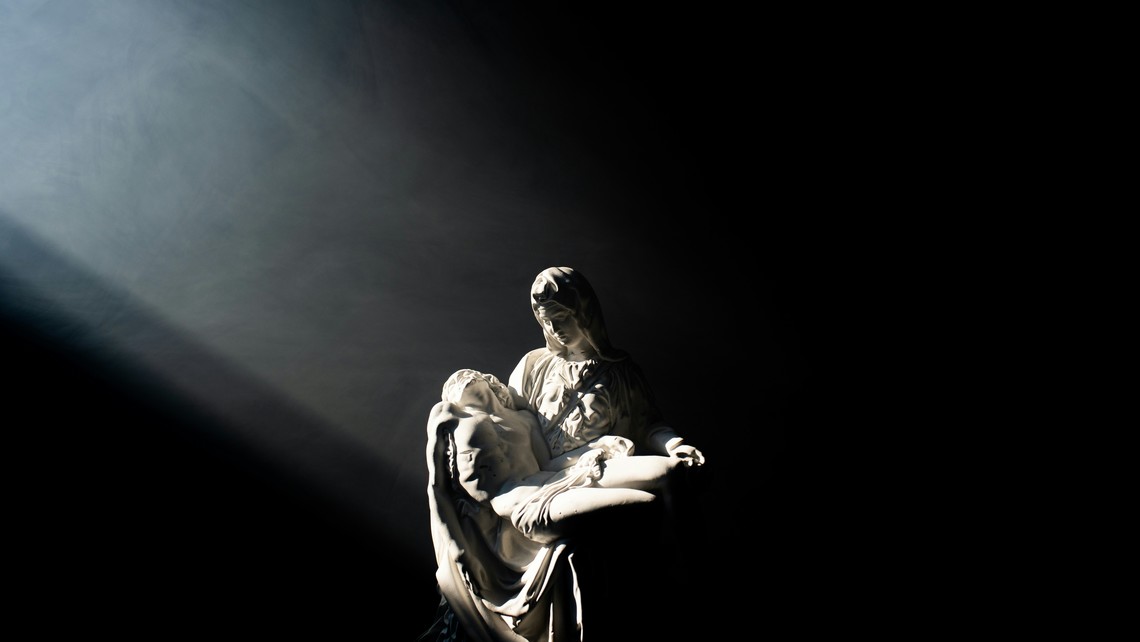
When Simeon finally encounters the Christ-child and proclaims the significance of his birth, he proclaims that Jesus represents the fall and rise of many in Israel. He tells both Mary and Joseph that they will also experience the pain and sorrow of the death of their Son, so that many may receive the gift of Jesus’ death (Lk 2:33-35). The exchange between Simeon, Mary, and Joseph describes the first sorrow Mary, the Mother of Jesus, will endure. She receives a direct message that forecasts the death of her Son. The significance of the Seven Sorrows of Mary is that each depiction, from Simeon’s proclamation to the flight into Egypt, the loss of the young Jesus at the temple, Joseph’s death, the meeting on the way of the Cross, and the removal and burial of Jesus’ body from the cross, reveals a surrender to the will of God and, at the same time, a unity with His suffering.
In his wonderful book The Lord, Romano Guardini describes how Mary’s response to the angel Gabriel enacted a trust in God that would lead her to encounter darkness beyond human comprehension. Mary’s destiny was shaped by that of her child. This is soon evident in the grief that steps between herself and her betrothed; in the journey to Bethlehem, the birth and danger of poverty, the exile and Simeon’s prophecy (p. 9). Mary’s sorrowful encounters reveal the depth of man’s willingness to kill her Son. Guardini tells us that God followed man into the no-man’s land that sin had ripped open. God not only glanced down at him and summoned him lovingly to return; he personally entered into that vacuous dark to fetch him (p. 398).
Guardini’s description of God following man into the depths of his sin reveals what the Blessed Mother, I argue, probably endured during the sorrowful encounters on the way of the Cross, Jesus’ death, and resurrection. The title Our Lady of Sorrows, instituted by Pope Pius VII in 1814, demonstrates how we are to engage suffering both spiritually and physically. She provides us with a path to understand grief, embrace the way of the Cross of her Son, and contemplate the necessity of suffering as a path to holiness that ultimately may lead to heaven.
To understand the Seven Sorrows of Mary as a path to holiness is to acknowledge the necessity of the Incarnation, why the Word of God took on human form. This affirms Mary’s role as a model of spiritual and holy docility, which serves as the seed of sanctification and holiness. As he suffered with her Son on the way of the Cross and at the foot of the Cross, she witnessed the atrocity of her Son’s death at the hands of man while knowing that her Son’s death was in the liberating act of redemption necessary for the salvation of man. The sorrows of our Blessed Mother reveal how we are to engage the Incarnation, and more specifically receive her Son in the Holy Eucharist within the holy sacrifice of the Mass. It is the Mass that serves as a literal and true reminder of Jesus’s sacrifice at the Last Supper and the Cross. Both are intimately bound together as part of the salvific plan, in which the Blessed Mother served as a maternal mediator. She cooperated in God’s salvific plan through her Immaculate Conception and ultimately as the Mother of God.
The Seven Sorrows of Mary remind us that suffering does not impede our relationship with Christ. On the contrary, it confirms it and serves as a doorway to acknowledge the gift of suffering as a path to holiness. The desire to have a relationship with Christ, one that will open our hearts and minds to the will of God, requires that we have an understanding of why Christ suffered, died, and rose from the dead. The Seven Sorrows of Mary guide us toward this understanding and bring to light the Via Dolorosa, the way of suffering, confirming our path to holiness.
O most holy Virgin, Mother of our Lord Jesus Christ,
by the overwhelming grief you experienced
when you witnessed the martyrdom,
the crucifixion, and the death of your divine Son,
look upon me with eyes of compassion,
and awaken in my heart a tender
commiseration for those sufferings,
as well as a sincere detestation
of my sins, so that,
being disengaged from all undue affection
for the passing joys of this earth,
I may sigh after the eternal Jerusalem,
and that henceforward all my thoughts
and all my actions may be directed
towards this one most desirable object:
Honor, glory, and love to our divine Lord Jesus,
and to the holy and immaculate Mother of God. Amen.
St. Bonaventure
Latest Posts

The Primacy of Teaching As an Act of Love
The identity of a teacher is often misperceived as an individual who simply conveys information, regurgitates concepts, and assesses a student's academic competency. In...Read more
The Grammar of Catholic Education
In the letter to the Hebrews, [1] the author makes a statement of faith that presumes two things about the exercise and practice of...Read more
The Diaspora of Catholic Education
In the encounter between Simeon and the child Jesus in chapter two of St. Luke’s Gospel, we witness a very specific act of faith...Read more
