



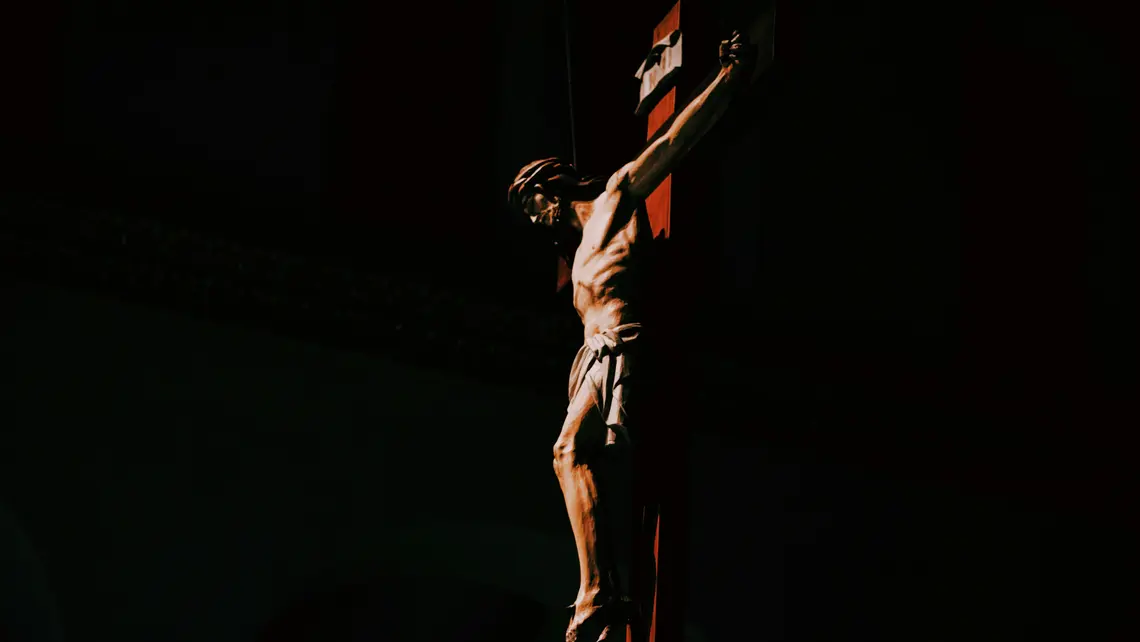
Several years ago, a former high school student asked me to explain why, after Jesus' death, his message about salvation continued. From his perspective, what was the point of continuing to believe in someone who had apparently died in vain? I appreciated my student's succinct question as it was the type of discourse encouraged in the classroom. In response, I told him that Jesus died because your life was not made in vain. It was made to be cared for, cultivated, respected, nourished, and nurtured with profound dignity and respect. Our original parents lost sight of the gift they had received from God and chose another path apart from God. From that point forward, God our Father sought to renew what was lost by becoming the very human being he created through a woman preserved from original sin who would bear His only-begotten son, and ultimately offer His son through a sacrificial death for the sins of humanity and ultimately their salvation.
The context behind my student’s question was his difficulty in believing whether the death of Christ for our sins and salvation was worth it. From his perspective, his encounter with the people of the day who express no faith in Jesus Christ or very little left him with an impression that Jesus died in vain. The people of today appear to express more disdain for Jesus and anything religious. Should we even learn about Jesus Christ and the Catholic Church he instituted through the Apostles?
The great lay Theologian and Master teacher Frank Sheed once described that the aim of religion is to assist the student to develop a tremendous devotion to Christ with an awareness of Him, knowledge of his life and personality, and a desire to continue to learn more of him (Are We Really Teaching Religion, 2). An important point that Sheed makes in his explanation of teaching religion is to help the student develop a desire to learn more of him. Any student of the faith who desires to mature in their relationship with Christ will ultimately be led to events of his death and resurrection. There is no avoiding the fact that the events of Jesus' life were ultimately directed toward his crucifixion.
Man had progressively fallen in his understanding and view of God. No longer was man made for God, but, instead, God made for man. This was the prevailing thought that had befallen both Jew and Gentile over the centuries prior to the birth of Christ. Man had developed a religious mindset that the law of God as revealed to Moses was theirs to define and interpret as they saw fit; this was the thought of the religious authorities who feared the messages Jesus conveyed to the people of God. So great was the fear held by the Sanhedrin-the religious and juridical Jewish authority of that day that their only recourse to silence Jesus, the Son of God, was by death. Jesus' message and acts of faith and healing disturbed the religious establishment of the day and caused great confusion and loss of an acquired identity that was far from the Mosaic law and ultimately the law of Christ.
The Prophet Isaiah foretold of the one who would return and be a ransom for many (Is 53:11); In St. John’s Gospel, Jesus describes a true disciple as one who is free from sin, and that He came to deliver us from the chains of sin (Jn 8:34-36). St. Paul reminds us that Christ, in accordance with Scripture, is the divinely revealed Word of God (1 Cor 15:3). On the Road to Emmaus, after the two disciples explain to Jesus who Jesus was, what he did, and how he died, lamenting that Jesus’ entire mission appeared to be in vain, Jesus reminds them that He had to die and enter into his glory (Lk 24:25-27). In interpreting the Scriptures to the Ethiopian Eunuch, Philip reveals the Good News of Jesus Christ, which ultimately led to the Ethiopians desire to enter the Kingdom of God through baptism (Acts 8:32-35).
The death of Christ was not the end but the beginning. St. John the Baptist reminds us of this when he declares the Son of Man as the Lamb of God who came to take away the sins of the world (Jn 1:29). The Catechism reminds us that Christ’s death is both the Paschal sacrifice that accomplishes the definitive redemption of men, through the Lamb of God who takes away the sins of the world, and the sacrifice of the New Covenant which restores man to communion with God by reconciling him to God through the blood of the covenant, which was poured out for the forgiveness of sins (CCC 613).
When teaching about the death of Christ to anyone, there is no dissociation between our life and Jesus’ death. Our life, both spiritual and carnal, is predicated on the love our Father in heaven has for us, fully revealed through the death of His Son on the cross. Jesus’ death was neither in vain nor the end but the beginning of our new life with God through His Son. The death of Christ reveals God’s unconditional love for us and our path to eternal life. Death was not the end but the beginning of our new life in Christ through His Church and the sacramental life that serves as a reminder that His death was not in vain.
Apart from the Cross, there is no other ladder by which we may get to heaven.
St. Rose of Lima
CCC 918
Latest Posts

St. John Bosco reminds us: Teaching children is a labor of love
Intention is an important attribute in teaching because it proposes a deliberate act of the will to do or act on something or someone....Read more

Remember the heart speaks to the heart
Frustrated that her students would not respond to her, she naturally wondered what was wrong. She modeled her teaching techniques after some of the...Read more

Every human life deserves to hear the Gospel and be configured to Jesus Christ
In his marital masterpiece, Love and Responsibility , St. John Paul II describes the love between persons as a mutual relationship, a particular form...Read more
